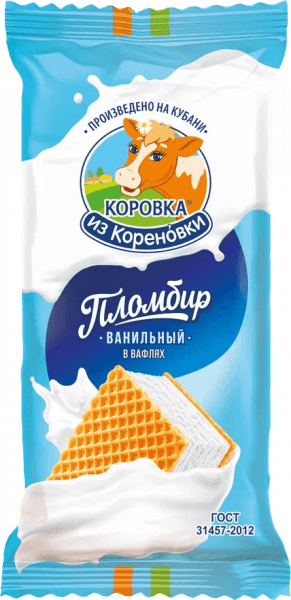
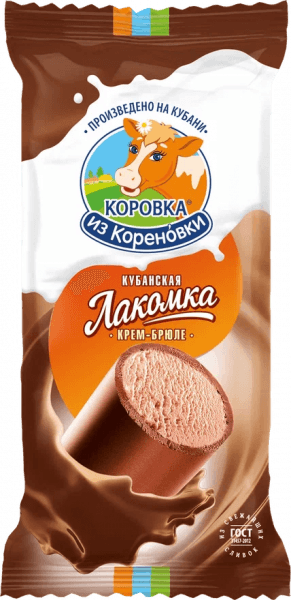
Korovka iz Korenovki (Коровка из Кореновки) is a Russian dairy brand from Korenovsk, a town in Krasnodar Krai in southern Russia, made at a dairy that has been in production since 1952. The name means, roughly, the little cow from Korenovsk. That cow is most of the story: a plain drawing of a farm animal doing the work of a place, a state standard, and a style of ice cream built on butterfat rather than on additions.
This is the story as far as it can honestly be told — where Korenovsk sits and why that matters for milk, how old the dairy is and how much younger the brand is, what the word korovka carries in Russian, why a plain cow reads so clearly in a post-Soviet freezer case, and how Ice Country LLC brings the brand to the United States. Where the record is thin, we say so instead of filling it in.
Where Korovka iz Korenovki comes from: Korenovsk, Krasnodar Krai
Korenovsk is a town in Krasnodar Krai, the southern Russian region usually called the Kuban. It is farm country: flat, warm, black soil, inland from the Black Sea and north of the Caucasus foothills. The Kuban is one of Russia's main agricultural regions, and dairy is a substantial part of what it does. That is the useful half of the geography. Milk does not travel well, so dairies tend to sit inside the milk shed they draw from, and a product built on butterfat has a reason to be near the herds.
Naming the region is a commitment. Korovka iz Korenovki is not a placeless label — the second half of the name is a town, the way Vologda butter or Adygean cheese carry their regions in the same breath as the product. Russian shoppers tend to read a regional dairy name as a claim about closeness to the milk, and a name like that is hard to borrow. A recipe can be changed quietly. A town cannot.
The dairy is old, the brand is young
The plant in Korenovsk began production on 30 December 1952, when the first can of sweet product came off the line. Construction had started in 1950, which puts the whole project in the post-war rebuilding years rather than in any older tradition. Read the date the way the company states it: 1952 marks the start of dairy work on that site, not an unbroken corporate entity. Soviet plants were reorganized, merged, renamed, and re-chartered repeatedly across the century, and the private company operating today is not the enterprise that existed then.
The brand is a great deal younger than the plant. «Коровка из Кореновки» was created in 2004, so the cow on the pack is about twenty years old while the dairy behind it has been running for more than seventy. Both things are true at the same time, and confusing them is how heritage claims usually go wrong. What the plant carried out of the Soviet decades was not a name. It was a way of working.
The plant worked inside the GOST system: centralized recipes, the milk-fat ladder that put plombir at the top, the limits on what could be substituted for dairy. Under those rules a plant had little room to compete on formula, because the formula was largely written for it. What was left to compete on was milk, handling, and consistency. When the standards stopped being compulsory, the habits outlasted them, which is why so many post-Soviet dairies still describe themselves in GOST-era terms rather than in terms of new inventions.
What Korovka iz Korenovki means
Коровка из Кореновки translates as the little cow from Korenovsk. Korova is cow, and the -ka ending is a diminutive — the suffix Russian uses to make a word affectionate rather than merely smaller. Korovka is closer to dear little cow than to small cow, and it is stressed on the second syllable, ka-ROV-ka. Then the place name does something a translation loses: Korovka and Korenovki share a run of sounds, so the phrase half-rhymes with itself. It is a jingle before anyone sets it to music.
English speakers usually meet the brand as Korovka and stop there, which is fine, but the second half is the part Russian ears actually hear. The construction is folkloric. It sounds like the opening line of a children's rhyme, which is a useful register for a dairy when a good share of its customers are parents standing at a freezer case with a child attached to one hand.
Why the word korovka turns up everywhere in Russian
The word arrives warm. Korovka has been the common name of a soft milk-fudge sweet in Russia for generations, made by many different producers rather than owned by one, so most Russian speakers met the word on a candy wrapper long before they met it on a freezer pack. A ladybug, meanwhile, is a bozhya korovka — literally God's little cow. None of that is the brand's doing. It is the ground the brand name landed on.
This matters for anyone searching in English. Korovka on a candy tin and Korovka iz Korenovki on ice cream are not the same product line, and the shared word is a feature of the language rather than a family relationship. If you are looking for the ice cream, the second half of the name is the part that identifies it.
Why a plain cow reads so clearly in a post-Soviet freezer case
Soviet packaging worked differently from Western branding. Under GOST the category carried the information — plombir named a defined grade, not a marketing idea — so a wrapper did not have to argue for itself. What it had to do was be identifiable at a glance, often at a street kiosk, often by a child holding coins. The result was a visual language built from simple, literal pictures: a cow for milk, bears for a chocolate sweet, a cone drawn as a cone.
A cow on a dairy pack sits inside that inherited grammar. It is not a mascot in the American sense, with a name and a backstory and a voice, and it is not trying to be clever. It is a statement of category, drawn plainly. For a lot of people who grew up in the former USSR, the plainness is the signal — the pack that says least is often the one that trusts the product. Nostalgia gets the credit now, but legibility came first.
What the brand tends to mean to people who grew up with it
Ask someone from the former Soviet Union about ice cream and you rarely get a brand first. You usually get a format and a place: the kiosk on the corner, the wafer sandwich eaten walking, the paper cup with the flat wooden spoon, the log sliced onto plates when guests came. People often describe ice cream as one of the few things that was reliably good and reliably there, which gave it more emotional weight than a dessert normally carries.
So what many shoppers in the diaspora are really buying is not a flavor but a check against a memory, and that test is quick and unforgiving. It is the least sentimental kind of nostalgia there is. If you are running the test yourself, these are the things worth paying attention to.
- The first spoonful should read as milk and cream, with the flavor arriving a beat later rather than leading.
- A cup should feel heavy for its size, because density is the hardest quality to fake with a label.
- A Lakomka shell should crack when you bite it instead of bending around the bar.
- The melt should slump into cream rather than collapse into foam or hold its shape like a sponge.
- The finish should be clean, with nothing waxy left behind on the roof of the mouth.
What Korovka iz Korenovki makes
The range is organized by format rather than by flavor, which is normal for Russian ice cream and mildly confusing for American shoppers who pick chocolate or vanilla first. Plombir cups are the plainest read on the dairy itself. Lakomka is the bar under a thick chocolate shell. Eskimo is the chocolate-coated bar on a stick. Then there are waffle cones, wafer sandwiches, and Poleno, a sharing log you slice into rounds and put on plates when people come over.
Choose the shape for the occasion and the flavor second. A cup is a sit-down dessert and the fairest test of a dairy. A bar is for walking. A Poleno is a course rather than a snack — the format that turns ice cream into something you serve instead of something you hand over. The lines share the same plombir style, so what mostly separates them is the shell, the shape, and how fast the thing goes soft in your hand.
How Ice Country LLC brings Korovka iz Korenovki to the US
In the United States, Korovka iz Korenovki is distributed by Ice Country LLC, which runs korovkaicecream.com. You can order direct with a $65 order minimum, and local delivery is free in South Florida and New York City. Deliveries are temperature-controlled and arrive frozen, which is the one part of moving ice cream across a country that cannot be improvised. There is also a Korovka Ice Cream iOS app, if reordering from a phone suits you better than a browser.
Wholesale covers the Northeast — New York, New Jersey, Pennsylvania, Connecticut, Massachusetts, Rhode Island, New Hampshire, Vermont, and Maine — plus Florida, and retailers can apply at /signup. For anything else, email info@icecountry.com or call +1 (475) 309-8943. That map is worth stating plainly rather than dressing up: outside those areas, free local delivery is not something we can offer yet, and a store near you is the better route.
Frequently asked
What is Korovka iz Korenovki?
Korovka iz Korenovki (Коровка из Кореновки) is a Russian dairy brand based in Korenovsk, a town in Krasnodar Krai in the southern farming region known as the Kuban, where the dairy has been in production since 1952. Its ice cream is made in the plombir style, the high-butterfat category Soviet standards defined by milk fat, and it comes in cups, bars, cones, sandwiches, and sharing logs.
What does Korovka iz Korenovki mean in Russian?
It means, roughly, the little cow from Korenovsk. Korova is cow and -ka is an affectionate diminutive, so korovka reads as dear little cow. The word is common in Russian outside the brand as well: it has long been the name of a milk-fudge sweet made by many producers, and a ladybug is a bozhya korovka, God's little cow. The ice cream is identified by the second half of the name.
How old is Korovka iz Korenovki?
There are two answers, and they are different. The dairy in Korenovsk has been in production since 30 December 1952, so the plant is past seventy. The brand «Коровка из Кореновки» was created in 2004, so the name on the pack is about twenty. We state 1952 as the start of dairy work on the site rather than as a claim of unbroken corporate history, since Soviet plants were reorganized and renamed repeatedly.
Why is there a cow on the packaging?
Because Soviet packaging communicated by picture rather than by slogan. Under GOST the category itself carried the meaning, so wrappers had to be readable instantly at a kiosk, often by a child. A cow said dairy without a word of copy. The name reinforces it: korovka is an affectionate Russian diminutive for cow.
Is Korovka iz Korenovki the same ice cream people remember from the USSR?
It is made in the same plombir style — the high-butterfat category defined by historical Soviet GOST standards — by a dairy in a region known for milk. GOST here means a historical Soviet state standard, not a current certification of any particular tub. The honest test is the one people already use: buy one cup and see whether it matches the memory.
Where can I buy Korovka iz Korenovki in the United States?
Order online at korovkaicecream.com, where Ice Country LLC handles US distribution, or through the Korovka Ice Cream iOS app. There is a $65 order minimum, and local delivery is free in South Florida and New York City, temperature-controlled and arriving frozen. Retailers in the Northeast and Florida can apply for wholesale at /signup, or reach us at info@icecountry.com.