The short answer to plombir vs American ice cream: plombir is denser, colder on the tongue, and built around butterfat, while American ice cream is usually lighter, sweeter on first contact, and engineered to survive a long trip to your freezer. Soviet standards for plombir set a high milk-fat minimum and restricted what else could go in. US rules set a lower floor and leave far more room to build texture other ways.
Neither approach is wrong. They solve different problems. Plombir grew up as something eaten soon after it left the freezer, usually as a single wrapped portion, often on the street. An American pint was made to sit in a home freezer for weeks and still scoop. Once you know what each style is optimizing for, the differences in fat, air, and additives stop looking like quality rankings and start looking like design decisions.
What plombir actually is
Plombir (пломбир) is a traditional Russian and Soviet ice cream style, not a flavor. The defining trait is high butterfat with a short, dairy-forward build. Soviet GOST standards, the state standards that governed food production, set minimum milk-fat levels for plombir, commonly cited at roughly 12 to 15 percent, and restricted what else could go in.
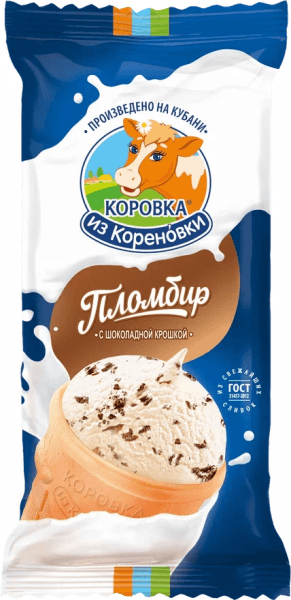
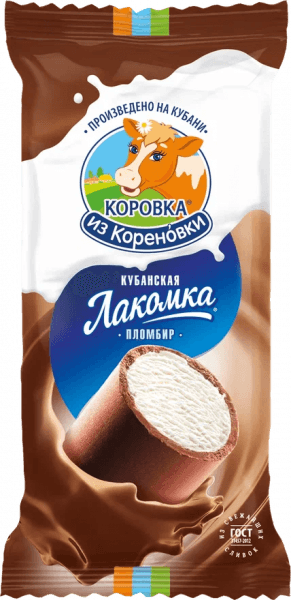
GOST is a historical Soviet framework rather than a certification a modern product automatically carries. Treat the word on a package today as a style descriptor and a statement of intent: dairy first, air low, flavor list short. Korovka iz Korenovki works in that tradition, made at a dairy in Korenovsk, in Russia's Krasnodar Krai, that has been in production since 1952.
How much butterfat is in plombir vs American ice cream?
Butterfat is the single biggest lever. In the US, a frozen dessert has to carry at least 10 percent milkfat to be labeled ice cream. Budget tubs tend to sit near that floor, and premium pints commonly climb into the mid-teens, so the plombir band overlaps the top of the American range while sitting well clear of the bottom of it. Fat does three jobs at once: it carries flavor compounds that water cannot hold, it coats the tongue so taste lingers, and it leaves less free water available to freeze into crystals. That last point does more for texture than most people expect.
Two label details are worth knowing before you compare numbers. First, the 10 percent floor is a naming rule: a product below it is commonly sold as frozen dairy dessert rather than ice cream, which is why that phrase shows up on so many supermarket cartons. Second, fat is measured by weight of the finished product, so two tubs with the same fat percentage can still eat completely differently. What separates them is air, and air is the next section.
Overrun: how much air is whipped into the tub
Overrun is the industry term for air. It is measured as the percentage of volume a mix gains during freezing, so 100 percent overrun means the finished ice cream is half air. US federal rules limit this indirectly by requiring a minimum weight per gallon, which is why a cheap half gallon can be very light but not infinitely light. The plombir tradition runs low. Less air means more ice cream per spoonful, a colder first impression, and a slower collapse in a warm hand.
- Overrun is not printed on any label, so net weight against stated volume is the only proxy a shopper actually gets.
- That makes the scale more informative than the front of the package: two identical-looking containers can differ enormously in weight.
- Low-overrun ice cream feels colder on the tongue because each bite carries more frozen mass and less insulating air.
- High overrun is not a defect. It makes ice cream lighter to eat in large portions and much easier to scoop straight from a cold freezer.
Stabilizers, gums, and why American ice cream uses them
Guar gum, locust bean gum, carrageenan, cellulose gum, and mono- and diglycerides are common sights on American frozen dessert labels. They bind free water, slow melting, and above all protect against heat shock, the partial thaw and refreeze that happens on a loading dock, in a grocery cart, and every time a freezer door opens. That is real engineering, not a shortcut. The plombir tradition attacks the same problem from the other end. With enough butterfat and little enough air, the fat itself does much of the structural work.
Soviet standards restricted additives, which pushed the style down the fat-first route. It is a harder and more expensive way to make ice cream, and it is less forgiving of a warm supply chain. That is why plombir is worth buying from someone who keeps it frozen the entire way. Korovka delivery is temperature-controlled and arrives frozen, with free local delivery in South Florida and New York City on a $65 order minimum.
Serving temperature: the trade each style makes
Home freezers run around 0°F (-18°C), and most ice cream tastes better a few degrees warmer than that. The asymmetry is that the two styles lose different amounts in the trade. Plombir keeps its flavor in the fat, and fat needs a little warmth to release it, so a cup straight from a deep freezer reads stiff and muted next to what the same cup becomes a few minutes later. A lighter American product carries more of its impact in sweetness and in added flavor compounds, both of which land fine while very cold.
That is a design difference rather than a serving tip. American ice cream is engineered to be scoopable and enjoyable at household freezer temperature, because a home freezer is where it lives for weeks. Plombir assumes a short wait, which is easy at a table and impossible in a hand — and that assumption is precisely why the coated bar, the cone, and the sharing log exist as separate formats with their own timing. The format-by-format numbers are a separate guide.
Portion size and format culture: bar vs pint
The formats are not accidents. Russian ice cream culture is single-serve and portable: a wrapped bar, a small cup with a flat spoon, a cone in a paper sleeve, eaten on the street and with a long-standing reputation for being eaten in winter. Portion control is built into the wrapper. American ice cream culture is centered on the home container and the scoop shop, where the pint, the half gallon, the sundae, and the mix-in do the work. One tradition perfected the single serving, the other perfected the shared tub.
You can read the whole Korovka lineup through that lens. Lakomka and Eskimo bars, waffle cones, and wafer sandwiches all follow one-person logic. The Poleno log is the exception that proves the rule: a frozen roll meant to be sliced at a table for several people, closer in spirit to an ice cream cake than to a pint eaten with one spoon.
How plombir and American ice cream actually taste
Plombir reads as cooked cream first. Vanilla arrives late and stays. Notes of caramelized milk sugar sit naturally in the style, which is why crème brûlée is a long-running plombir flavor rather than a novelty. The texture is dense and clean, and it melts toward cream rather than foam. Good American ice cream reads brighter and sweeter on contact, and it is a far better carrier for inclusions, because cookie pieces, candy, and thick ribbons need air and structure to stay suspended in the base.
Run the melt test if you want the difference in one experiment. Leave a spoonful of each on a plate for twenty minutes at room temperature. A high-fat, low-air ice cream collapses into something that looks like heavy cream. A heavily stabilized one holds its shape much longer, then slumps into a foam that never quite becomes liquid. Neither result is a verdict on quality. It is a readout of which lever the maker pulled.
Plombir vs American ice cream, side by side
Here is the comparison in one place. Treat the American column as a range rather than a rule, since the category spans supermarket economy tubs and small-batch pints that behave much more like plombir. The differences below hold on average, and they are the ones you can feel with a spoon rather than read off a label.
- Butterfat: the Soviet plombir standard is commonly cited at roughly 12 to 15 percent milk fat, while US rules set the ice cream floor at 10 percent and premium American pints often reach the mid-teens.
- Air: plombir is made at low overrun and eats dense, while much American ice cream carries considerably more whipped-in air, which makes it lighter and easier to scoop cold.
- Texture engineering: the plombir tradition leans on butterfat and low air for body, while modern American production commonly uses gums and emulsifiers to control ice crystals and slow the melt.
- Serving temperature: plombir rewards a few minutes of tempering out of the freezer, while lighter, airier ice cream is closer to ready straight from 0°F.
- Format: plombir culture is built around single-serve bars, cups, and cones, while American culture is built around pints, half gallons, and scoop-shop servings.
- Flavor logic: plombir puts dairy at the center and uses flavors as accents, while American ice cream often treats the base as a canvas for inclusions and swirls.
Frequently asked
Is plombir better than American ice cream?
It depends on what you want from a scoop. Plombir gives you density, a long dairy finish, and a small portion that satisfies. American ice cream gives you lightness, easy scooping, and a much wider world of mix-ins and swirls. They are built for different moments, not ranked on one scale.
How much fat does plombir have compared to regular ice cream?
Soviet GOST standards for plombir are commonly cited at roughly 12 to 15 percent milk fat, which is above the 10 percent floor US rules set for anything labeled ice cream. Premium American pints can reach a similar range, so the more reliable difference is often air content rather than fat alone.
Why does plombir feel denser and colder than American ice cream?
Two reasons. Lower overrun means less air per spoonful, so each bite carries more frozen mass. And higher butterfat leaves less free water to form large ice crystals, so the texture stays smooth and solid rather than fluffy. Density is the trait most people notice before they notice flavor.
Does plombir contain stabilizers and gums?
The Soviet standard restricted additives, so the plombir tradition relies on butterfat and low air for body instead of leaning on gums. That is a description of the style, not of any single package. For what is in a specific product today, read the ingredient panel on that product.
Why is American ice cream easier to scoop straight from the freezer?
Air, mostly. More whipped-in air means less frozen mass per scoop and a softer body at any given temperature, so a scoop parts easily at 0°F. Stabilizers help too, by binding free water so the product stays plastic rather than rock-hard. Plombir has less of both, which is the same reason it eats denser and colder once you are past the first spoonful.
Where can I try plombir if I have only ever eaten American ice cream?
Start with a plain vanilla cup rather than a flavor you already like, because the comparison only works on the base. Korovka is ordered online at korovkaicecream.com or through the iOS app, with a $65 order minimum and free local delivery in South Florida and New York City, temperature-controlled and arriving frozen. Retailers in the Northeast and Florida can apply for wholesale at /signup.