If you are looking for where to buy Russian ice cream in NYC, you have two real options. The first is the Russian and Eastern European grocery stores clustered in Brighton Beach, Sheepshead Bay, Bensonhurst, Rego Park, and Forest Hills, where plombir is common freezer stock. The second is ordering online from Korovka for free local delivery anywhere in New York City on orders of $65 or more.
Which one you want depends on how much of a hunt you enjoy. The neighborhood stores are worth the trip: you get the whole category in front of you, cups and bars and logs, mostly labeled in Cyrillic. Delivery is worth it if you live outside those pockets, if you are buying for a party, or if you would rather not carry a melting box home on the subway.
Brighton Beach and Sheepshead Bay: the default answer
Brighton Beach Avenue, under the elevated subway tracks, is the stretch most people mean when they talk about Russian food shopping in New York. Many of the stores follow the same pattern: prepared salads and smoked fish at the front, dry goods in the middle, a wall of freezers at the back. Ice cream usually sits there, shelved near the pelmeni and vareniki rather than in anything resembling an American pint section. Sheepshead Bay, just inland, is quieter and more residential, with smaller markets along Sheepshead Bay Road and the side streets off Emmons Avenue.
Two practical notes. The busier stores turn their freezers over quickly, which is usually good news for texture, but the ride home is long. Brighton Beach to midtown is the better part of an hour by subway, and a cup that softens and refreezes is never the same again. Buy ice cream last, bring an insulated bag, and ask for extra plastic if the store has it.
- Full-size gastronoms tend to carry the widest freezer selection and move stock the fastest.
- Small corner delis usually stock a handful of familiar formats, mostly cups and coated bars.
- Bukharian and Central Asian markets often shelve Russian dairy alongside Uzbek and Georgian goods.
- International supermarket chains sometimes keep a short Eastern European freezer section, though selection varies week to week.
- Bakeries and prepared-food shops occasionally run one chest freezer near the register, so it is worth a look even when the store is not a grocery.
Rego Park and Forest Hills: the 108th Street corridor
In Queens, the center of gravity is 108th Street around Queens Boulevard, the commercial spine of a largely Bukharian and Russian-speaking community that spans Rego Park and Forest Hills. The mix is different from Brooklyn's. Central Asian breads and Georgian pastries turn up in the same trip, and the freezer selection often reflects that wider post-Soviet geography rather than a strictly Russian one.
Stores here tend to run mid-sized rather than warehouse-scale, so the ice cream case can be a single door instead of a whole wall. Check two or three storefronts rather than settling for the first. The 63rd Drive-Rego Park stop on Queens Boulevard drops you near the top of the strip, and the walk south covers most of it.
Bensonhurst and the rest of South Brooklyn
Bensonhurst is the quieter case. Russian-speaking delis and markets are interleaved with Italian and Chinese retail along 86th Street, Bay Parkway, and 18th Avenue, so you are looking for a single storefront rather than a whole strip. The same is true along Coney Island Avenue through Midwood and Gravesend, where a market can carry a full freezer without advertising it from the sidewalk.
Outside these pockets the map thins fast. Manhattan and the Bronx have far less of this retail, and Staten Island has Russian-speaking pockets with much less of it per block. If you live north of the park, or off the Brooklyn and Queens lines that serve these neighborhoods, the trip is most of an afternoon. That gap is the practical argument for delivery.
Reading a freezer case labeled in Cyrillic
Most of these boxes are labeled in Russian, and the packaging often does not translate itself. A short glossary covers nearly everything you will see in the case, and it is the difference between guessing and choosing.
- Мороженое (morozhenoe) just means ice cream. It is the generic word, not a style.
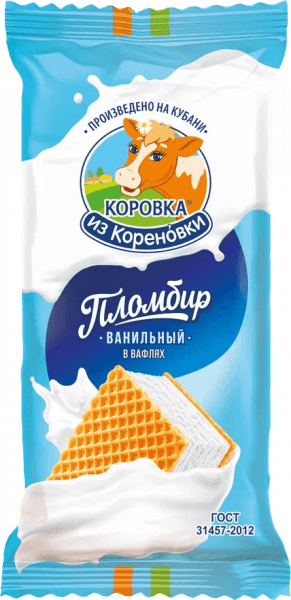
- Пломбир (plombir) is the high-milk-fat style, traditionally the richest grade in the Soviet system.
- Сливочное (slivochnoe) and молочное (molochnoe) traditionally sit below plombir on milk fat, in that order.
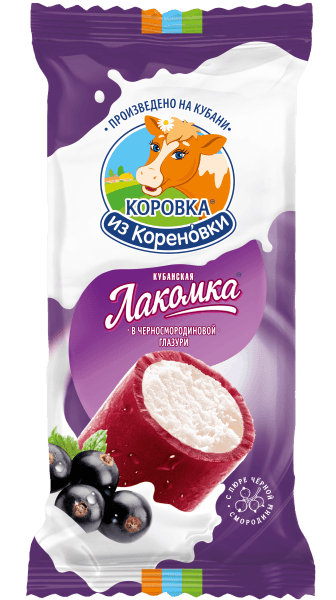
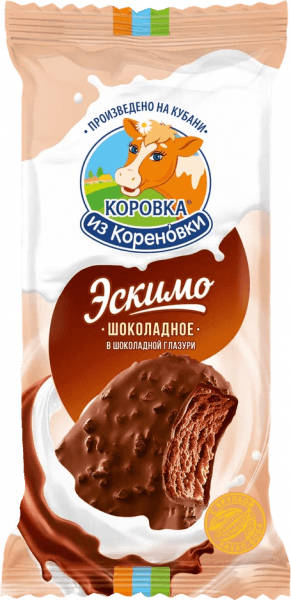
- Эскимо (eskimo) and лакомка (lakomka) are both bars finished with a chocolate coating.
- Рожок (rozhok) is a waffle cone, стаканчик (stakanchik) a cup, полено (poleno) a log you slice for a table.
- Common flavor words: ванильный vanilla, шоколадный chocolate, крем-брюле crème brûlée, вишня cherry, чёрная смородина blackcurrant.
What to look for in the freezer case
Start with the label. Пломбир (plombir) is not a flavor, it is a category: the high-butterfat end of the Soviet dessert canon. Then pick the box up. Density is the fastest quality check you can run in a store, because cheaper ice cream is whipped with more air, and between two boxes of the same size the heavier one is usually the better one. Finally, look for damage from temperature: frost inside the wrapper, a dented or hardened corner, or a chocolate shell that reads dull rather than glossy.
- A chocolate shell on a Lakomka-style bar should crack in sheets when you bite it, not bend or smear.
- A waffle cone should snap; a cone that gives softly has taken on moisture somewhere warm.
- Frost crystals on the surface of the ice cream mean it thawed and refroze at some point.
- Let a cup stand a few minutes before eating so it reads dense and smooth rather than icy.
- Prefer the store with the fullest, coldest case, since a lone box in a half-empty freezer has had more chances to soften.
Ice cream in a New York winter
The part that confuses people who did not grow up with it is that this is cold-weather food. Ice cream was sold from kiosks through the Soviet winter and eaten standing outside in a coat, and the habit crossed the ocean intact with the neighborhoods. Walk the boardwalk at Brighton in February and you will pass someone working through a wafer sandwich with the wind coming straight off the water. The logic is not perverse. A dense, high-fat ice cream eaten outdoors in freezing air stays exactly as it left the freezer, which is the one condition it was built for.
That inverts the advice you would give in a warm city. Winter is the easy season in New York: the walk from the store costs you nothing, and a coat pocket works as a cooler. Summer is the hard one, and the specific problem is not the sidewalk but the platform. An elevated station on the Brighton line in July runs well above street temperature, and the train you want is nine minutes out. In August, buy for the same day and take the shortest route home rather than the cheapest one.
Where to buy Russian ice cream in NYC without leaving home
Korovka delivers direct to customers in New York City. Orders start at $65, and local delivery within the city is free at that minimum. The delivery is temperature-controlled and the order arrives frozen, which is the part a subway ride cannot promise. You can order from korovkaicecream.com or from the Korovka iOS app. The practical version: build a $65 order across formats rather than buying one box at a time, and clear the freezer space before it lands.
The lineup covers the formats you would find in those neighborhood freezers: plombir in cups, Lakomka bars under a chocolate shell, chocolate-coated Eskimo bars, waffle cones, wafer sandwiches, and Poleno, the log you slice for a table. If you are new to the category, a mixed order is the honest way to learn which one you actually want.
Buying for a party, or for your store
For a table, Poleno is the format that does the work: one log, sliced into rounds, feeds a group without handing out twenty wrappers. Cups and bars are the better call for a freezer you are stocking for the month. If you run a store, a bakery, or a restaurant, Korovka's wholesale program covers New York, New Jersey, Pennsylvania, Connecticut, Massachusetts, Rhode Island, New Hampshire, Vermont, and Maine, plus Florida. Retailers can sign up at /signup, or reach Ice Country LLC at info@icecountry.com or +1 (475) 309-8943.
Frequently asked
Where can I buy Russian ice cream in NYC?
Two routes. In person, the Russian and Eastern European grocery stores in Brighton Beach, Sheepshead Bay, Bensonhurst, Rego Park, and Forest Hills usually keep plombir in the back freezers. Online, Korovka delivers free within New York City on orders of $65 or more, arriving frozen.
Does Korovka deliver ice cream in New York City?
Yes. Local delivery in New York City is free on orders of $65 or more, and the handoff is temperature-controlled, so the order arrives frozen rather than softened. You can place an order on korovkaicecream.com or through the Korovka iOS app. Walk-up buildings and fifth-floor apartments are the usual case here, so pick a window when someone is home.
Do people really eat this outdoors in a New York winter?
Constantly, and it is the default rather than an eccentricity. Ice cream was sold year-round from Soviet kiosks and the habit came over with the neighborhoods, which is why Brighton Beach freezer cases do not empty out in January. Cold weather is also the best handling you will ever get: nothing softens between the store and your kitchen.
Which NYC neighborhood has the most Russian grocery stores?
Brighton Beach is the usual answer, with the highest concentration of full-size Russian food stores in the city along a few blocks of Brighton Beach Avenue. The 108th Street corridor through Rego Park and Forest Hills is the strongest option in Queens, while Bensonhurst has scattered delis rather than one strip.
Can I get Russian ice cream delivered outside New York City?
Free local delivery covers New York City and South Florida. Wholesale accounts run across the Northeast, including New York, New Jersey, Pennsylvania, Connecticut, Massachusetts, Rhode Island, New Hampshire, Vermont, and Maine, plus Florida. If you are outside those areas, email info@icecountry.com or call +1 (475) 309-8943 to ask what is possible.
How do I keep it from melting on the way home?
Buy the ice cream last, bring an insulated bag, and plan the trip. A ride from Brighton Beach into Manhattan is the better part of an hour, which is enough to soften a cup. Ice cream that softens and refreezes turns icy, and the original texture does not return.